Video is exploding. It is how we learn, communicate, and increasingly experience the world.
Tens of millions of new videos are uploaded every day. Short-form video is watched hundreds of billions of times daily. Video feeds have spread far beyond entertainment into everyday software, from food-delivery apps to investing platforms. Organizations that once operated outside media – from startups to venture firms – now produce video to shape their brands and strengthen distribution.
The shift is not only that more video is being recorded. Each valuable recording is now expected to produce far more derivative content. In the broadcast era, a football game was largely a single product: the television broadcast itself. Today, the same game becomes highlight packages, vertical clips, sponsor assets, personalized recaps and post-game stories. A movie becomes trailers, features and social edits. A live news feed becomes a broadcast segment, a site clip, several short-form versions and future archive material.
Everyone is competing for human attention. The economics of distribution reward more formats and greater frequency. Audiences increasingly expect video shaped for their platform, language, interests and available attention. The number of possible outputs keeps growing. The time and labour available to make them does not.
AI-generated video adds fuel to this fire. It is the most visible part of video AI today, and for good reason. A few words can now produce footage that once required cameras, a crew, a set and a VFX team, or create something that previously existed only in our imagination.
Yet many people and organizations working with video already possess enormous amounts of valuable recorded reality: games, performances, interviews, live events and archives. Their problem is not a shortage of video. It is that they cannot economically watch, understand and reuse all the valuable footage they already have.
This is the simple asymmetry. The amount of video we can capture, retain, and consume scales with storage and infrastructure. The amount we can understand still scales largely with human attention.
This growing imbalance will not be solved by making the mechanics of editing incrementally faster. Editing software spent a century helping people manipulate footage; it did far less to help software understand what the footage contains. The next shift begins there. Once footage, taste and context become understandable to machines, agents can take on more of the mechanical work around an edit. To see why this matters, it helps to look at how editing software evolved—and what it never solved.
A Century of Editing Software Solved the Timeline, Not the Meaning
In the early decades of film, editing was physical. Editors viewed workprints, cut celluloid and spliced it back together. Commercial videotape arrived in 1956, and electronic tape-to-tape editing became common in the 1960s. It removed the physical cut but remained linear: shots were copied to a master in sequence, and changing an early decision could mean rebuilding what followed.
During the 1970s and 1980s, offline and non-linear systems separated the editorial decision from the final recording. Avid Media Composer made random-access digital editing practical for professional film and television in 1989. Editors could jump to any frame, compare alternatives and rearrange sequences without rebuilding them from the beginning. Adobe Premiere and Final Cut Pro brought non-linear editing to increasingly affordable computers during the 1990s. Cloud tools later moved review beyond the edit suite, while transcript-led tools like Descript made dialogue editable through words. Machine learning began handling narrow tasks such as synchronization, silence removal, captions and clip suggestions.
These were more than interface improvements. The timeline organized video by time. Descript organized it by words. The next generation of editing software will organize it by meaning.
Each transition removed mechanical work and democratized capabilities that once required expensive equipment and specialized workflows. Film no longer had to be physically cut. Tape no longer had to be assembled in sequence. Non-linear systems made experimentation cheaper, and Resolve brought professional color and audio tools onto desktop computers. Expertise did not disappear; the quality floor rose and fewer technical handoffs stood between an idea and its expression.
But the central constraint moved rather than disappeared. Someone still had to understand the source. The craft of editing has never been defined by operating the timeline alone. It lies in recognizing what happened, which performance was strongest, how a reaction changed the meaning of a scene, whether a quote became misleading without context and which moment best served the assignment. A visually striking moment may be wrong for the story, while an imperfect pause may carry its emotional truth. Editing then means assembling those choices into a story. The difference between an ordinary cut and a great one is rarely mechanical skill alone; it is what the editor and director are able to see in the material.
Bins, filenames, transcripts and metadata could organize footage, but only as well as the understanding captured within them. Much of the visible progress in editing software focused on timelines, effects, templates and exports. Meanwhile, a large share of the work remained before and around the cut: following feeds, watching footage, logging shots, finding story beats, checking usability, preparing versions and moving work between people and systems. Only a small fraction of what is recorded reaches the audience, but that shooting ratio understates the labor required to find it.
The same constraint appears at every scale. In a single-editor workflow, one person can retain the source knowledge and editorial intent from the first watch to the final cut. The limit is that person's time and attention. Inside a media enterprise, the problem compounds. The same footage may be inspected by an assistant, revisited by a producer, cut by an editor and checked again for rights, context or standards. People become the integration layer, carrying why a moment matters and what has been verified across every handoff.
One hour of source can therefore consume several hours of attention before any of it becomes publishable. Editing software made the hands faster. The next shift must help the eyes and memory scale. That requires software that can begin understanding footage before an editor has watched all of it—and explicit context that agents can carry through the work that follows.
The building blocks for that shift have been forming for years.
VLMs Turn Detection Into a Continuing Assignment
Computer vision has automated parts of video work for years. Earlier systems worked best when the target was known in advance: a face, shot boundary, logo, object or specific sports event. Speech recognition created transcripts. OCR extracted on-screen text. These systems worked well when the question was narrow and clearly defined.
Their strength was also their limit. A new editorial question often required a new model, taxonomy, or set of rules.
Vision-language models change what software can be asked to do. Instead of defining every object or event in advance, an editor or team can give the system an open-ended brief. A model can combine sampled frames with speech, on-screen text and metadata to infer what may matter for that particular assignment.
For editing, closing the loop begins with perception. Models must see more than people and objects: they must perceive exposure, color, composition, movement and continuity at frame level. They must hear more than words: speakers, emphasis, rhythm, ambience, noise and the relationship between dialogue, music and effects. Without this signal-level understanding, a model may assemble footage but cannot reliably judge or improve the edit.
The significance of smaller models is not that they can match the best cloud systems on every task. It is that not every video task requires the best model available. A smaller production might index footage on an editor's workstation, while a media enterprise may hold petabytes of footage on-premise. In both cases, moving and processing every hour through a frontier model simply to identify people, scenes or broad events would be economically irrational. Smaller models can watch where the footage already lives, build a first-pass index and pass only the relevant moments to more capable models for deeper interpretation. This creates a cascade: lower-cost local understanding across everything, with expensive frontier reasoning used only where it adds value. That is what makes machine-scale watching economically plausible.
The larger shift is a persistent, timestamped context layer over the footage. It can connect source identity and exact timestamps with transcripts, people, actions, dialogue, relationships and project metadata. That context can remain attached as the footage, assignment and people working on it change.
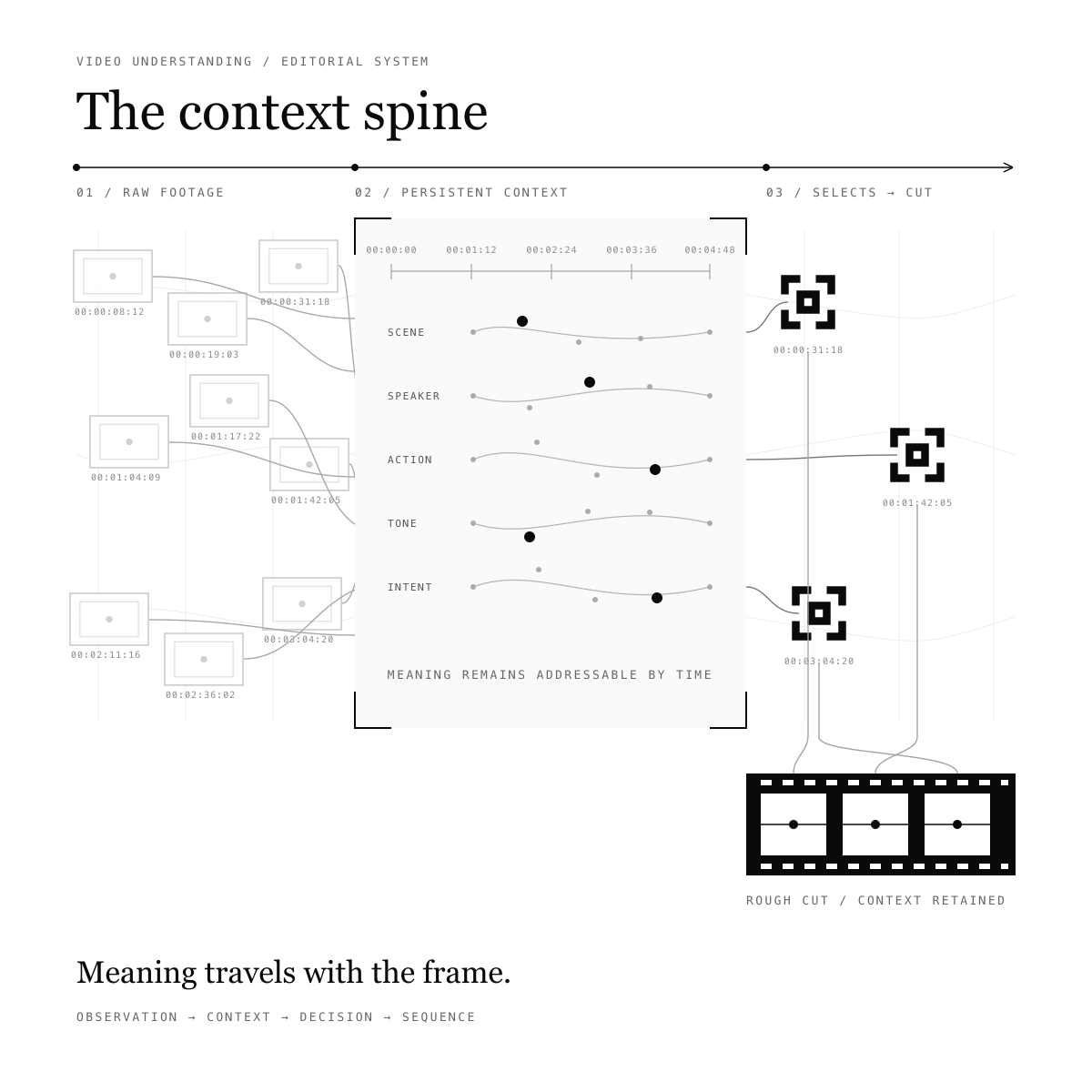
This becomes a shared memory for video. An agent can use it to search the archive, generate logs, surface relevant moments, extract clips, prepare selects and build a rough cut. Each task no longer has to begin again from an opaque video file.
The implication extends beyond a single edit. Media libraries are largely systems of record: they preserve files, ownership and metadata. Once the same source-linked understanding can support archive search, live monitoring, logging, clipping and assembly, its value compounds across workflows rather than ending with a single output.
The economic consequence is larger than faster edits. Archives can become active inventory rather than sunk storage. More live feeds become economically observable. The same library can support more formats and more personalized outputs without requiring human attention to scale linearly with the amount of footage.
The timeline does not disappear; it remains where editorial judgment becomes visible. But the opportunity moves upstream—from helping editors manipulate footage they have already found to helping them understand more of the footage available to them.
Automate the Work Around the Story
Agentic editing should shorten the distance between editorial intent and the work required to express it. A decision made once should retain its context as footage moves through monitoring, logging, editing, review, versioning and delivery, rather than being translated or rebuilt at every step.
Current systems cannot yet carry that decision reliably from end to end. Open-ended video understanding is already useful, but frame-level precision, provenance, correction, governance, editability and integration remain uneven. A compelling model output is therefore not the same as an accountable production workflow.
That gap is clearest when software produces candidates. Ten plausible clips generated in seconds create no leverage if an editor must watch, repair and approve all ten. The relevant measure is not output volume, but the time and attention required to reach an approved result. Automation is useful only when verification costs less than manual discovery.
When systems cross that threshold, editors and editorial teams can start from a broader and better-organized view of the material. Directors can compare more performances, editors can explore more structures, and producers and journalists can follow more live material and reach deeper into archives. Machines provide breadth, continuity and recall; people decide what matters, what the story says and how it should feel.
Agentic video editing does not need to automate authorship to transform media production. Its value is in carrying context and removing repetitive work before and between creative decisions. The future of editing will be defined by how much more editors and editorial teams can see, consider and make with the attention they already have.